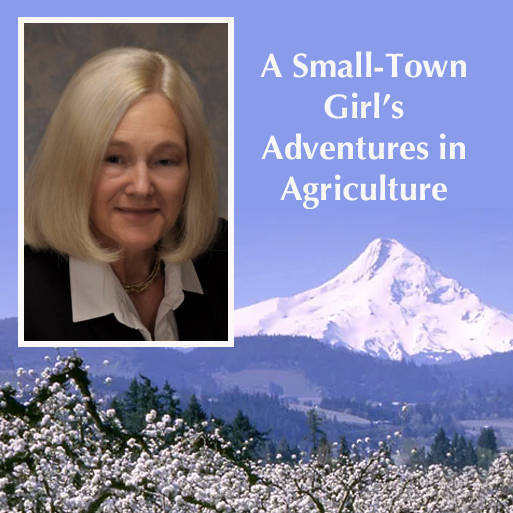
Beers Delivers Keynote Address and Tree Fruit IPM Outreach
Tree Fruit IPM Extension Specialist Betsy Beers had the honor of delivering the keynote address at the 100th Orchard Pest & Disease Management Conference in Portland in January. Her talk, A Small-Town Girl’s Adventures in Agriculture, traced her early interest in agriculture and entomology through her decades of service to tree fruit growers, along with anecdotes from past OPDMCs dating back to the mid-1980s.
Also in January, Beers presented What is the Minimum Conventional Program for Hard Economic Times? and Netting: Codling Moth Control and Natural Enemy Impact at the North Central Washington Apple Day in Wenatchee and Net Gains: Balancing Codling Moth and Aphid Control under Drape Nets at the Apple Crop Protection Research Review in Yakima.
Beers’ IPM outreach presentations in February included Apple IPM for the Lean Times at the Northwest Wholesale Okanogan Grower’s Meeting in Omak; Timing Insecticides for Control of Thrips and Woolly Apple Aphid at the Wilbur-Ellis Apple Day (webinar); Codling Moth Control: Physical and Chemical at the Okanogan Horticultural Society Annual Meeting in Okanogan; and Codling Moth Control Options: Ford Fiesta to Cadillac and All Points In Between at the Northwest Wholesale Wenatchee Grower’s Meeting in Wenatchee.
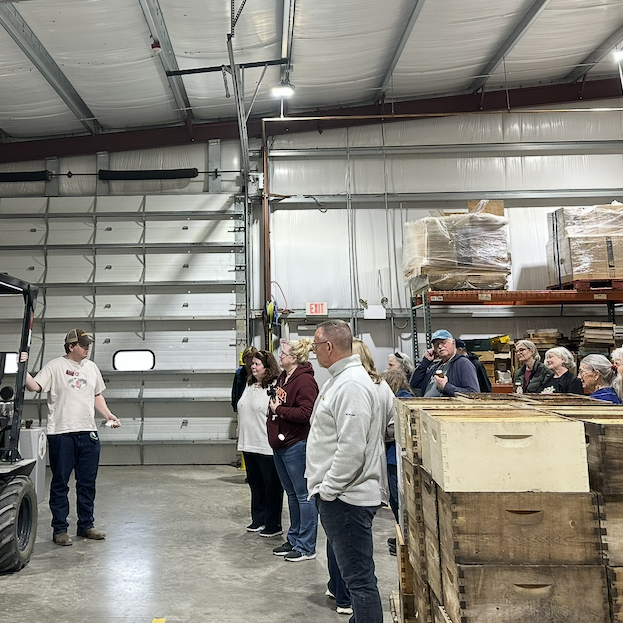
Conference Presentations, Tours, and New Videos for Bee Health
Honey Bee Health Specialist Brandon Hopkins and WSU Bee Program members attended the American Beekeeping Federation/American Bee Research Conference in Mobile AL, where they conducted outreach on entomopathogenic fungi for Varroa mite management, supplemental feeding during carrot seed pollination, and use of microscopy to diagnose Nosema spp. infection.
Bee team members presented about pollinator-pesticide interactions at various WSU pesticide applicator recertification courses, spoke at the Sandhill Crane Festival, gave several guided tours of the WSU Othello Bee Program Facility, and hosted two webinars about progress on multi-institutional research into dynamics of European foulbrood infections.
The team’s article Induced brood breaks by refrigerated bee storage in spring: an effective strategy for Varroa destructor (Mesostigmata: Varroidae) control in honey bee colonies was recently published in Journal of Insect Science.
A new bilingual video series titled A.B.E.J.A.S. was released on the WSU Bee Program YouTube channel. Filmed in both Spanish and English, the series provides comprehensive overviews of honey bee biology, nutritional needs, pests, pathogens, predators, and other topics. While designed with commercial operations in mind, the content is applicable for beekeepers at all levels. Funding was provided by the USDA Agriculture and Food Research Initiative (AFRI) Critical Agriculture Research and Extension (CARE) program and Project Apis m.
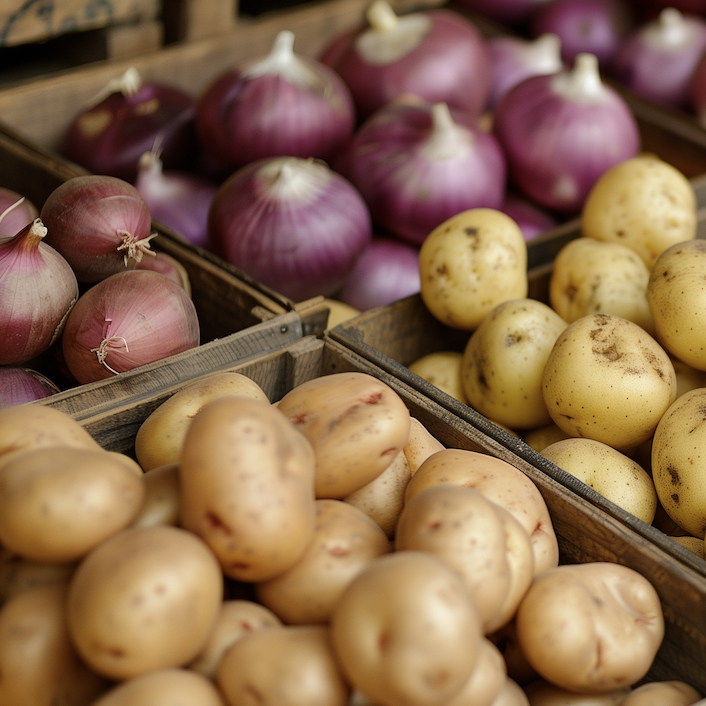
Potato, Onion, and Seed Crop IPM Presentations
Regional Vegetable Specialist Tim Waters participated in the Washington & Oregon Potato Conference in January, where he organized and moderated the Spanish language session and also gave an update on a multi-state Specialty Crop Research Initiative project on which he is a Principal Investigator, entitled Enhancing Integrated Insect Pest Management Strategies for U.S. Potato Production Systems. The conference, held in Kennewick, drew over 2,500 attendees.
Waters also spoke at the Columbia Basin Seed Growers and Processors annual meeting in January, presenting Wireworm Control in Seed Crops, a talk that covered pest biology, scouting methods, and pesticide best practices in an IPM context for the various crops represented. The event was held at the WSU Honey Bee and Pollinator Center near Othello.
In February and March, Waters’ IPM outreach presentations included: insect pests (seedcorn maggot, thrips) and diseases of onion at the AgriNorthwest annual agronomy meeting; two sessions (one basic and one advanced) on insect IPM implementation on a commercial farm at the Potato Academy sponsored by Washington Potatoes and held in Moses Lake; best management practices for diseases of potato to an audience of crop consultants; and a virtual workshop on how to utilize theWSU Potato Decision Aid System.
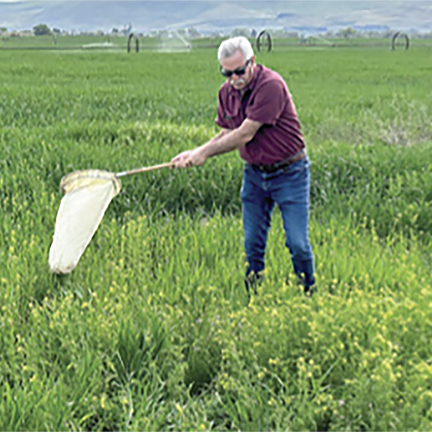
Nationwide IPM Presentations for Alfalfa Seed, Mint, and Hops
Washington State IPM Coordinator and Extension Entomologist Doug Walsh took to the road this winter, meeting with the agricultural stakeholders he serves at a variety of conventions across the country.
Walsh presented 2025 Lygus Control Studies on Alfalfa Produced for Seed and Predator & Parasite IPM on Alfalfa Leafcutting Bee Brood at the 57th Annual Winter Seed Conference of the Western Alfalfa Seed Growers Association in January. The key concern in growing alfalfa for seed is balancing protection of essential pollinators with control of pests. The conference was held in Savannah, Georgia.
Also in January, Walsh presented Managing Spider Mite Populations in Mint at the 47th Annual Meeting of the Mint Industry Research Council in Tucson, Arizona. Washington is a leading producer of both spearmint and peppermint, and Walsh has worked with this industry for over two decades.
Tucson was also the site of the 70th Annual American Hop Convention in January. This year’s conference theme was Facing the Frontier, a nod to both the convention location and the downturn in craft brewing and consequent hop production in recent years. The convention runs sequentially with the Hop Research Council Winter Meeting. Walsh presents an update on IPM in Washington State / Pacific Northwest Hops to these groups each year, with an emphasis on arthropod control.
Alternative SWD Management in Small Fruits Explored
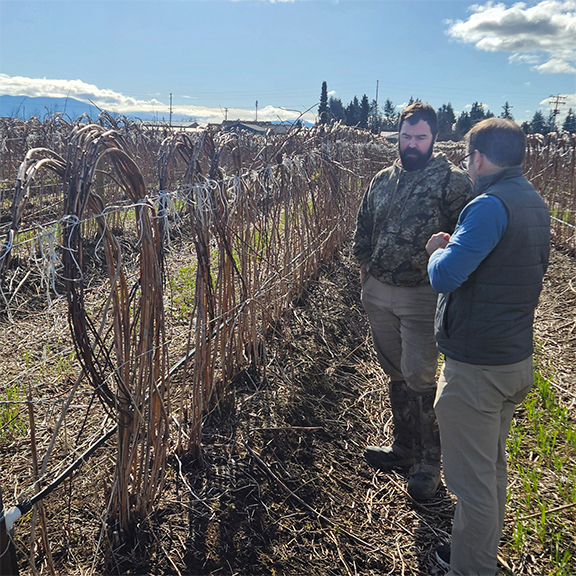
Horticultural Crop IPM Specialist Louie Nottingham and his lab were represented at the 85th Annual Pacific Northwest Insect Management Conference in January. Held in Portland, the conference addressed emerging issues, pollinators, pests within various crop systems, and management methodologies. Two of Nottingham’s PhD students had papers (co-authored by Nottingham) in the Small Fruits, Tree Fruits, and Nuts section of the conference.
- Claire Winslow presented Dropping Like Flies: Assessing Selective Insecticides for Drosophila suzukii Management, in which she described initial bioassay studies using an insect growth regulator (IGR) to reduce viable offspring in SWD.
- Nottingham presented Gusta Beard’s Field Evaluation of New Sterile Insect Release (SIR) Method to Control Drosophila suzukii, describing a preliminary trial in which sterilized male moths were released to compete with wild male SWD toward reduction of viable offspring. Beard was recently featured in a WSU Foundation Scholarship Spotlight article as an outstanding student and recipient of multiple scholarships with an impressive track record of community engagement. Nottingham presented a similar talk at the Western Washington Berry Workshop presented by WSU Skagit County Extension in February.
Nottingham invited Agragene to northwestern Washington to present their CRISPR-based SIR technology and meet with blueberry and raspberry stakeholders.
New Tools and Spray Optimization Outreach for Grape Growers
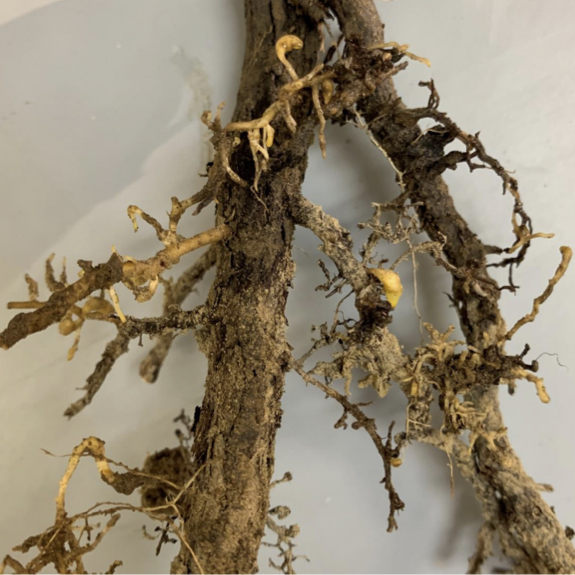
Statewide Viticulture Specialist Michelle Moyer teamed up with Timothy Miles of Michigan State University in February to present Assessing Your Spray Program: From Fundamentals to Field Application at the Oregon Wine Symposium in Portland. Moyer and Miles also conducted an Interactive Workshop on Optimizing Spray Programs for Varying Conditions, moderated by Peter Ebbers, Vineyard Manager and Viticulturist of Stirling Wine Grapes.
WineVit was also held in February. This year’s theme was Thriving and Innovating in Transition. Moyer joined Gwen Hoheisel, WSU Regional Extension Specialist, to present Smarter Spray Decisions: Using the New Digital Tools for Smart Grape Pest Management. In their presentation, Hoheisel and Moyer explained how to use the newly developed digital Crop Protection Guide and the Decision Aid System (DAS) for grapes.
Moyer continued her work with FRAME (Fungicide Resistance, Mitigation and Extension) Network. In 2026 and beyond, the multi-state FRAME team will offer several webinars related to grape disease management and fungicide resistance mitigation. Featuring presentations and hands-on activities, each will be about 90 minutes long. Registration information will be posted on FRAME’s Events page. These webinars are designed so that they can be regionally tailored and be hosted by local grower organizations, extension educators, or crop consulting companies; see FRAME’s Educator Information webpage.
IPM Outreach for Students and Farmers on the Olympic Peninsula
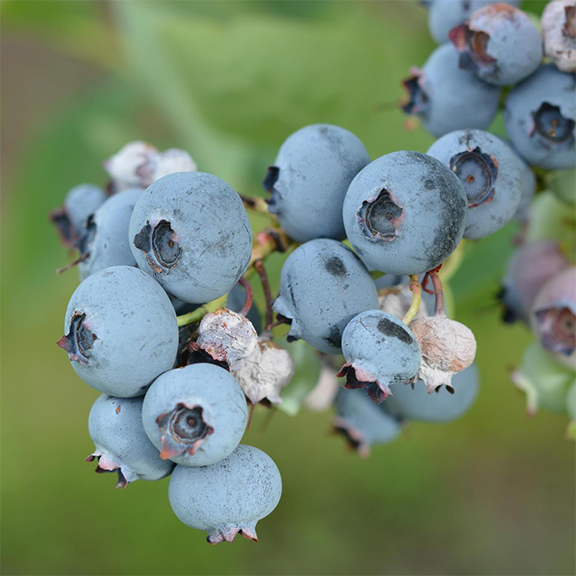
Regional Horticulture and IPM Specialist Laurel Moulton, with the WSU Extension Regional Small Farms Program, had the opportunity to teach high school and college students the principles of IPM in recent classes. Bainbridge Island High School offers a Horticulture class in partnership with local farms, focusing on sustainable practices, crop science, and farm business, allowing students to earn credits through real-world experience in gardens and greenhouses, connecting with the district’s broader Farm to School initiatives for fresh, local food education. Moulton partnered with Butler Green Farm to cover the basic concepts of IPM and introduce students to the Pacific Northwest Pest Management Handbooks, the Hortsense website, and other WSU publications and resources that they could access to help them apply IPM to pest and disease problems they might encounter in various horticultural careers.
Moulton also taught IPM to the Peninsula College propagation and plant production class, with a focus on greenhouse IPM and sourcing clean plant materials.
The WSU Regional Small Farms Team provides research-based information and educational programs to farmers and other stakeholders in Clallam, Jefferson, and Kitsap counties. Moulton recently provided technical assistance to farmers for
- Mummy berry in blueberries
- Control of wild radish and mustard in barley
- Shrub encroachment in pasture
- Buttercup management in pasture
Master Gardeners and Green School Reach Hundreds
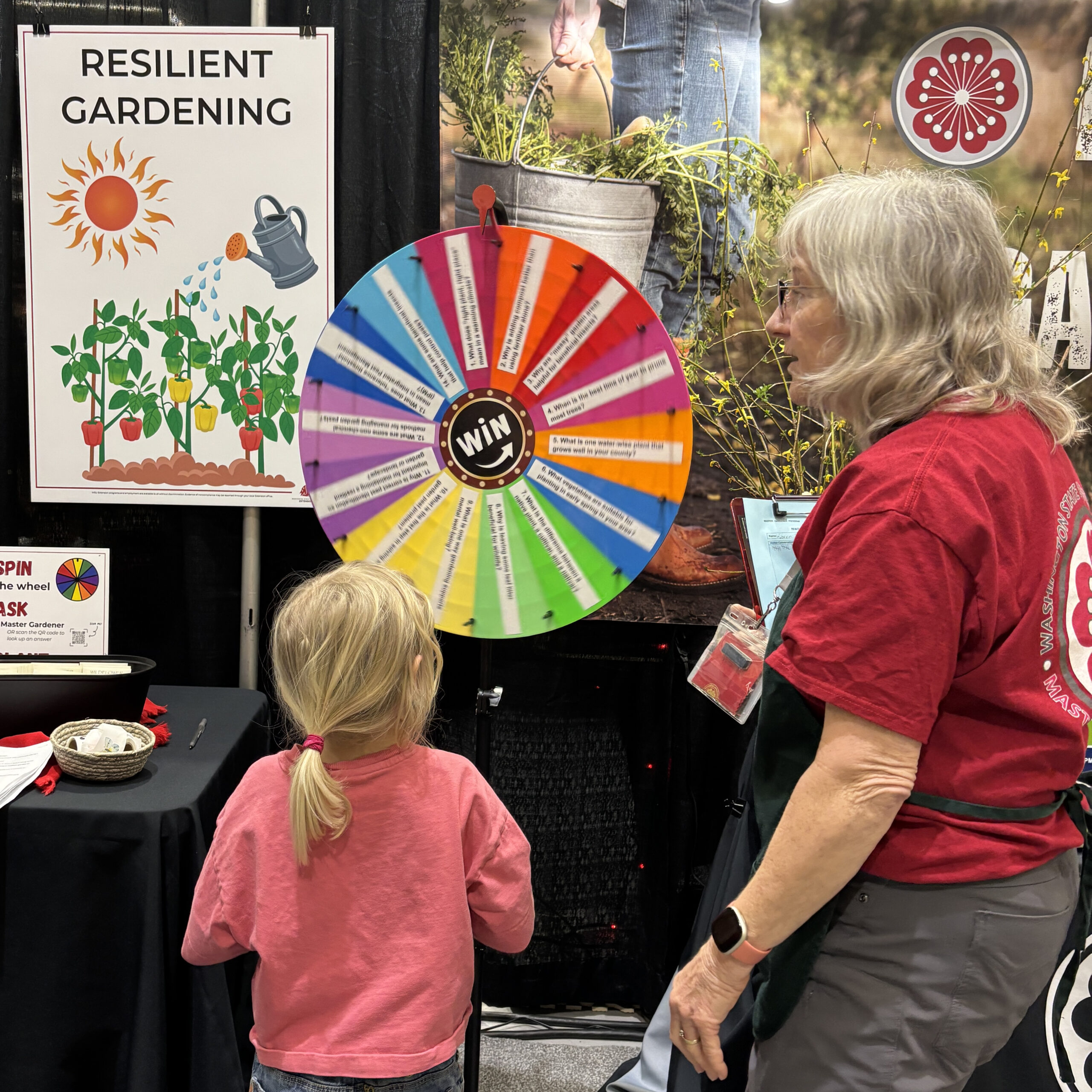
WSU Extension Master Gardener Program Director Jennifer Marquis reported that program volunteers, sponsored by the Master Gardener Foundation of Washington State and its member chapters, participated in the Northwest Flower and Garden Festival in February. Volunteers from around the state served in our Let’s Talk Gardening booth and conversed with 1500+ guests. One guest stopped to tell us that the WSU Master Gardener Program is the foundation for the entire festival providing gardeners with easy access to accurate horticulture information. A popular activity was spinning the wheel to win a packet of seeds. The wheel contained questions related to IPM and volunteers helped guests think through the answers. The wheel was located next to a poster with the IPM pyramid.
Another highlight of this season has been the continued success of Washington Green School, our statewide introductory horticulture and environmental stewardship course series. Of 1,000 registered learners, just over 800 have earned the Washington Gardener Certificate, demonstrating both their commitment and the strength of the curriculum.
Concurrently, approximately 550 learners are well on their way to becoming certified WSU Extension Master Gardener volunteers, building the future of the program and expanding its ability to serve communities across Washington with IPM outreach. Their enthusiasm, questions, and engagement speak volumes about the impact of this training pathway.